Table of Content 7
In short
-
Extremes are safe
After a 2, a higher call wins 11 times in 13 on a fresh deck, and the payout is small to match.
-
7 is a coin flip
Middle cards give near even odds and bigger multipliers.
-
Chains compound risk
Every extra guess risks everything you have built up so far.
The rules
- Place a stake A card is dealt face up as the starting card.
- Guess higher or lower The game shows the chance and multiplier for each choice. Many versions also let you skip a card.
- Win or lose A correct guess multiplies your stake, and the new card becomes the reference. A wrong guess ends the round.
- Continue or collect After each win you choose to keep going or take the current amount.
Cards rank ace (1), 2 to 10, jack (11), queen (12), king (13). Suits do not count. What happens when the next card has the same rank varies by game: some count it as a loss, others offer a separate 'same' bet. Check the rules screen.
HiLo is an instant game, so each round resolves in seconds without a dealer or other players. HiLo uses one reference card at a time, and the reference card changes after every correct guess. The starting card sets the odds for the first guess. The new card sets the odds for the next guess. This is why a HiLo round reads as a chain of separate decisions rather than one long bet.
The odds for each card
Most casino HiLo games, including provably fair ones, draw each card from a full, freshly shuffled deck. That makes the odds simple: they depend only on the card showing.
| Card showing | Chance higher | Chance lower |
|---|---|---|
| Ace | 12 in 13 (92%) | 0 |
| 2 | 11 in 13 (85%) | 1 in 13 (8%) |
| 4 | 9 in 13 (69%) | 3 in 13 (23%) |
| 7 | 6 in 13 (46%) | 6 in 13 (46%) |
| 10 | 3 in 13 (23%) | 9 in 13 (69%) |
| Queen | 1 in 13 (8%) | 11 in 13 (85%) |
| King | 0 | 12 in 13 (92%) |
Single card drawn from a full 52-card deck; same-rank cards (1 in 13) excluded from both columns
The table shows why HiLo odds are easy to read. Each card showing leaves 13 ranks in a fresh deck, and the chance of higher or lower is a count of ranks out of 13. A 4 has 9 higher ranks and 3 lower ranks, so a higher call wins 9 times in 13. A 7 has 6 ranks above and 6 below, which leaves 1 in 13 for the same rank.
The ace and king rows show the limits. An ace has no lower rank, so the lower chance is zero, and 12 in 13 ranks sit above it. A king mirrors that. In these rows one choice is close to certain and the other cannot win, which is why games usually pay the safe side very little.
The same-rank outcome matters more than it looks. The 1 in 13 chance of a matching rank is excluded from both columns in the table. The result depends on the game's rules, because some games treat a tie as a loss and others offer a separate bet. The chances shown in a game can therefore differ from the table when the game handles ties differently.
How multipliers and the house edge work
The payout for each guess is roughly the inverse of its chance, minus the house edge. A guess with a 50% chance might pay about 1.9x instead of 2x, while a 92% guess pays only a little over 1x. Chained guesses multiply: three correct guesses at about 1.9x each turn €10 into roughly €69, but the chance of getting all three right is about one in eight.
The house edge applies to every guess, so a long chain does not escape it. Safe guesses on extreme cards pay so little that they barely move your total.
The multiplier is the game's price for a guess. A low-chance guess pays a high multiplier, and a high-chance guess pays a low one. The house edge sits inside that price. The house edge is the gap between the multiplier the game pays and the multiplier a fair game would pay. The gap is small on each guess, but it applies to every guess in a chain.
The rules screen is the place to check the multiplier for each choice before you guess. This page cannot state one house edge for every HiLo game, because each game sets its own multipliers.
Chain length changes the risk more than any single card. Each added guess multiplies the payout, and it also multiplies the chances of winning together. Winning chances of 50% across three guesses give one in eight, as the example above shows. A longer chain makes the payout larger and the chance of reaching it smaller.
Practical habits
- Decide a collect point before the round, such as a target multiplier or a number of correct guesses.
- Use skip where the game allows it, to move past middle cards you do not want to bet on.
- Keep stakes flat. Raising stakes after a loss does not change the odds.
- Ignore streaks. On a fresh-deck game, a run of high cards says nothing about the next one.
A collect point turns a habit into a rule. Setting a target before the round removes the choice from the moment, when a winning chain makes the next guess feel safer than it is. The odds of the next guess do not improve because earlier guesses won. In a fresh-deck game, each guess depends only on the card showing.
Skip is the other tool. Where a game offers it, skip lets you pass on a card instead of guessing. Middle cards such as 6, 7 and 8 sit close to even odds, so skipping them removes the guesses with the least clear call.
Flat stakes keep results easy to measure. A fixed stake means a loss costs the same amount every time, so the session stays inside the budget you set. Raising stakes after a loss does not change the odds, and it speeds up the loss of money.
HiLo is a game of chance, and no habit removes the house edge. Set a deposit limit before you start and stop when you reach it.
Online gambling in Ireland is for adults aged 18 and over.
Gambling in Ireland is governed by the Gambling Regulation Act 2024.
Similar instant games
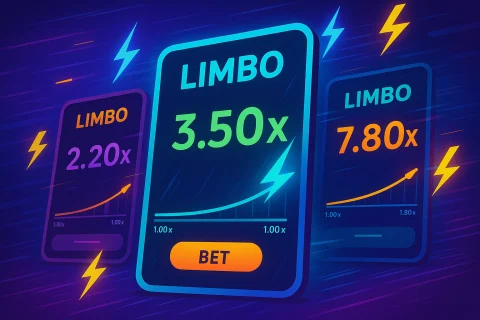
HiLo shares its risk-versus-multiplier choice with Dice, Mines, Plinko and Limbo. For ways to keep losses down, read HiLo risk reduction strategies.
Instant games share one structure: you set a stake, make a choice, and see the result at once. The choice in each game changes the odds and the multiplier. HiLo's choice is a direction, while the games linked above use other choices. Comparing the odds shown in each game before you play is the easiest way to see how they differ.
Mobile casinos with instant games in Ireland
-
- Bonus
- 25 EUR
- Wagering
- 10x
- You must wager
- €250
- Expected value
- +€15
18+ · T&Cs Apply · Play Responsibly -
- Bonus
- €600 + 500 FS
- Wagering
- 40x
- You must wager
- €24,000
- Expected value
- −€360
18+ · T&Cs Apply · Play Responsibly -
- Bonus
- 250 FS
- Wagering
- 35x
- You must wager
- –
- Expected value
- –
18+ · T&Cs Apply · Play Responsibly -
- Bonus
- €600
- Wagering
- 45x
- You must wager
- €27,000
- Expected value
- −€480
18+ · T&Cs Apply · Play Responsibly -
- Bonus
- 3,000 EUR + 100 FS
- Wagering
- –
- You must wager
- –
- Expected value
- –
18+ · T&Cs Apply · Play Responsibly
FAQ
How do you play HiLo?
Guess whether the next card will be higher or lower than the one showing. Correct guesses multiply your stake. You can collect after any win, and a wrong guess loses the round.
Which cards are the safest to bet on?
Aces, 2s, queens and kings, where one direction wins 11 or 12 times in 13. The multipliers are small to match.
Can I count cards in HiLo?
Only in the rare versions that deal from one deck without reshuffling. Most casino HiLo games draw each card from a full deck, so past cards do not matter.
What is the house edge in HiLo?
It is built into each multiplier, usually a few percent below fair odds. The game's rules screen often lists the RTP.
When should I collect?
At a point you set before the round. Each extra guess risks everything won in the chain.
Why do the odds change from card to card in HiLo?
The odds change because each card leaves a different number of higher and lower ranks. A 2 leaves 11 higher ranks and 1 lower rank in a fresh deck. A 7 leaves 6 higher ranks and 6 lower ranks. The game converts those counts into chances and multipliers, so a rarer outcome pays more.
What happens if the next card has the same rank?
The result depends on the game. Some games count a matching rank as a loss, and others offer a separate bet on it. A matching rank is 1 chance in 13 in a fresh deck. Read the rules screen before you play so you know which version you are using.
Does a winning streak make the next guess safer?
No. In a game that draws from a fresh deck, each guess depends only on the card showing. A run of wins does not change the odds of the next card. Treating a streak as a signal is the gambler's fallacy, and it leads players to chain more guesses than they planned.
Is HiLo a game of skill or chance?
HiLo is a game of chance with a decision layer. You choose the direction, whether to skip and when to collect, and those choices change the risk you take. They do not change the odds the game offers. No choice removes the house edge.